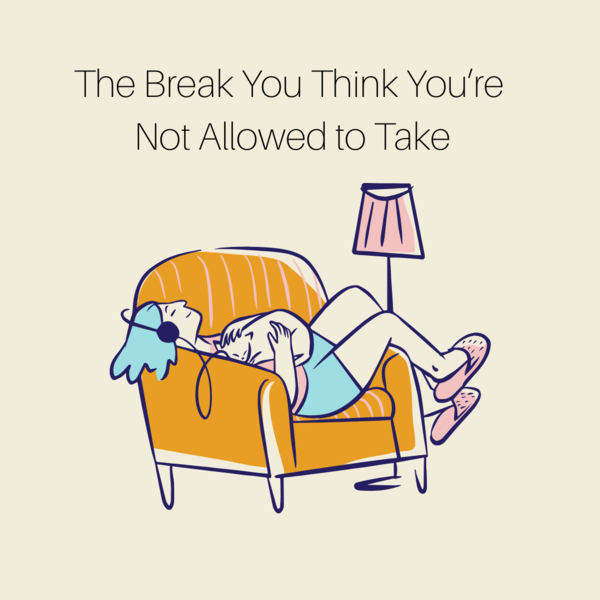
The Break You Think You're Not Allowed to Take
- lifeskills, conflict, future, experience, mentors, relationships, youth
- Housing, Money, Transitioning Out of Care, Resources for Parents, Guardians, Families, Resources for Professionals, Resources for Teens and Young Adults
When it comes to mental health in foster care, it’s something that every one of us, whether we were adopted or aged out, has a connection to. It isn’t some distant topic we learn about in training or pamphlets. For most of us, it’s woven into our stories from before we even entered the system. I won’t bore you with my story because I know full well that we all heard or survived worse. What I will do is try to untangle what mental health really looks like for youth in care.
We often hear about “self-care.” Most of the memories I have with counselors involve the same questions: “How are you doing?” or “Have you been taking care of yourself?” or “What self-care things have you been doing?” But let’s be honest: trauma isn’t as simple as slapping a face mask on and, boom, after 10 or 20 minutes, everything is solved. And after a heartbreaking panic attack, you can’t just write your feelings away while your hands are still shaking.
Healing isn’t aesthetic. It’s messy, unpredictable, and it doesn’t care whether you aged out, were adopted, lived in group homes, or bounced between placements for years. Once you step into the system, mental health becomes a second skin you didn’t ask for.
The worst part is that the issues we are dealing with often come from the people who were supposed to keep us safe. Now, we deal with the after-effects of their “love”: the sweaty palms, the nightmares, the trust issues, the dissociation, and more.
Take me, for example. I’ve been out of the system since 2018 and away from my abusers since 2011. Now I’m 23, adopted, and attending college. Many would see that as a success story. However, last Thursday, in a level 300 class, I got triggered and had one of my worst episodes this semester.
The video we were watching was about smuggling and human trafficking (an ancient 2006 documentary). I made it almost halfway until a survivor started talking about the moment she realized she had been trafficked, and how the other women held her as they cried with her. That moment hit something in me I didn’t expect, and boom...
My vision went hazy, my breathing became difficult, and you can guess the rest.
And by the way, don’t get it twisted, my day was beautiful. I had a sleepover with my best friend. I wore my favorite dress, put on a matching bonnet, and my favorite Ugg boots. The sun was shining. I even remember dancing and singing “T.G.I. Friday” by Katy Perry on the bus. As you can guess, my best friend wasn’t impressed by my singing and dancing skills. Two hours later, I was being carried to my room, sobbing, while my best friend held my hand and helped me breathe.
So much for a success story, right?
That’s the part people don’t talk about. Healing isn’t linear. A “success story” doesn’t erase the body’s memory.
But moments like that don’t mean we’re failing. They mean we’re human, and we’re carrying more than most people will ever understand.
Now, a week later, as I sit in my college cafeteria watching students come and go, some eating, others studying, I can’t help but chuckle. Looking at me today, nobody would guess that seven days ago I was almost sent to the hospital. Or that four of those seven days I was bedridden from how hard that episode hit my body. Nobody would guess how many times I cried while trying to force myself out of my room to go to class. Or that I pushed myself yesterday, showed up, and ended up having another attack that made me miss my second midterm.
And sitting here, blending in like nothing ever happened, I realized something. The world doesn’t see what our bodies carry. It doesn’t see the crashes, the recovery, the fear, or the shame. It doesn’t see the days we’re too drained to stand, or the nights we’re too overwhelmed to breathe. They only see the version of us that finally makes it out of bed, not the break we needed to take to get there.
And that realization hit me hard:
This isn’t just about me.
It’s about all of us who grew up in foster care, all of us who learned to survive by never stopping.
One thing foster care teaches us, without even saying it out loud, is that we’re not allowed to stop. We grow up always running, always surviving, always performing, always fighting to stay ahead of whatever catastrophe might be waiting around the corner. And because of that, taking a break feels wrong. It feels dangerous. It feels like failure.
But here’s the truth I’m learning the hard way:
Sometimes the most powerful thing you can do is stop.
Not collapse. Not give up.
Just… stop.
These last two weeks humbled me. My body shut down. My mind shut down. I skipped classes. I hid in my room. And at first, it felt like the old survival voice screaming: “You’re being lazy. You’re falling behind. You’re messing up.”
But the truth is, I needed that break. I needed the stillness. I needed the pause.
And when I finally had the strength, not when other people wanted me to, but when I felt steady enough, I advocated for myself. I dragged myself to Caroline, who is part of the Student Support for students struggling with anything that’s not academically based. I told her the truth. She got me to my doctor. I got my meds refilled. I got my doctor’s note. I protected myself from consequences. I took care of myself.
That’s what nobody talks about:
Rest is part of advocacy. Recovery is part of advocacy. Taking a break is part of advocacy.
If you need to drop everything for a few days, do it.
If you need to miss class to keep your sanity, do it.
If you need to lie still in bed for four days because your body feels like it’s made of cement, do it.
If you need to tell your foster parent, your adoptive parent, your professor, your boss, “I can’t today,” then say it.
Take the break.
Take all the time you need.
You don’t need permission to breathe.
But here’s the part that matters:
don’t stay buried forever.
When you feel even a tiny drop of strength return, advocate for yourself. Ask for help. Let someone make the call you can’t. Use the people around you whose voices carry farther than yours. Let them be your microphone.
Because mental health isn’t just surviving the breakdown.
It’s also learning how to rise (slowly, imperfectly, on your own timing) without apologizing for the rest you.
Resources:
If you need to reach out and talk to someone.
- National Alliance for Mental Illness - https://www.nami.org/ - The NAMI HelpLine provides the one-on-one help and information necessary to tackle tough challenges that you, your family or friends are facing. Call 1-800-950-6264, or Text "NAMI" to 62640, the HelpLine M-F, 10 a.m. - 10 p.m. ET. In crisis? Call or text 988 crisis service available 24/7.
- Kids in Crisis - https://www.kidsincrisis.org/get-help/ - Our trained Crisis Counselors help children and families cope with unsafe situations, family conflicts, substance abuse, mental health issues, school problems, and so much more. Call 1-203-661-1911. We are here to help you. Whether you’re a child, parent, relative, teacher, therapist, doctor, neighbor, friend, or anyone concerned about the welfare of a child, a Kids In Crisis counselor will answer your call 24 hours a day, every single day of the year.
- The Heartline - https://ocfs.ny.gov/programs/fostercare/heartline.php - The Heartline is a first-of-its-kind resource for youth ages 14 – 21 who are currently in, or who have recently left, foster care. Callers to The Heartline will access a caring, relatable responder who is a young adult with personal lived experience in foster care or the juvenile justice system in New York State. Call or text 877-328-6423 Tuesday-Saturday from 11 a.m.-7 p.m.